
867 lines
25 KiB
Markdown
867 lines
25 KiB
Markdown
---
|
||
tags:
|
||
- Go
|
||
- golang
|
||
- go进阶
|
||
- 反射
|
||
---
|
||
|
||
# 反射
|
||
|
||
## 什么是反射
|
||
反射可以认为是程序在运行时的一种能力,反射可以在程序运行时访问、检测和修改它本身状态,比如在程序运行时可以检查变量的类型和值,调用它们的方法,甚至修改它们的值。使用反射可以增加程序的灵活性,简单来说,反射就是程序在运行时能够检测自身和修改自身的一种能力。
|
||
|
||
## Go语言反射
|
||
对于很多的高级语言都实现了反射,像Java,Python。在Go语言中,反射在Go语言内置的`reflect`包下实现。Go语言中的反射建立在Go的类型系统之上,并且与接口密切相关。通过前面的学习我们知道Go语言的空接口包含类型(`Type`)和值(`Value`)两个部分,在反射里,也要用到类型(`Type`)和值(`Value`)。
|
||
`reflect`包中定义了`reflect.Type`和`reflect.Value`,正好对应我们前面所说的`Type`和`Value`。要注意的是`reflect.Type`是一个接口而`reflect.Value`是一个具体的结构体。在`reflect.Type`接口中定义了很多跟类型相关的方法,而`reflect.Value`则是绑定了很多跟值相关的方法。
|
||
|
||
### reflect.TypeOf()
|
||
由于`reflect.Type`是一个接口,所以只有当某个类型实现了这个接口,我们才能获取到它的类型,同时,在`reflect`包内,类型描述符是未导出类型,所以我们只能通过`reflect.TypeOf()`方法获取`reflect.Type`类型的值。
|
||
我们首先看一个例子,看下`reflect.TypeOf()`的常用用法:
|
||
```go
|
||
package main
|
||
|
||
import (
|
||
"fmt"
|
||
"reflect"
|
||
)
|
||
|
||
type Student struct {
|
||
Name string
|
||
Age int
|
||
}
|
||
|
||
func main() {
|
||
var num int64 = 100
|
||
t1 := reflect.TypeOf(num)
|
||
fmt.Println(t1.String())
|
||
|
||
st := Student{
|
||
Name: "zhangsan",
|
||
Age: 18,
|
||
}
|
||
t2 := reflect.TypeOf(st)
|
||
fmt.Println(t2.String())
|
||
}
|
||
```
|
||
运行结果:
|
||
```
|
||
int64
|
||
main.Student
|
||
```
|
||
可以看到对于基础类型和`struct`类型通过调用`reflect.TypeOf()`都打印出了对应的类型信息。注意`reflect.TypeOf`返回的是一个`reflect.Type`接口类型,我们通过调用这个接口的`String()`方法,得到最终的字符串信息。
|
||
|
||
在前面学习`interface`的章节中,我们知道一个具体的数据类型是可以赋值给一个`interface`类型的,反过来则不行,要用到`interface`的断言。在一个`interface`赋值之后,其实是对应了两个类型,一个是静态类型,就是在程序编译期就确定的类型,`interface`的静态类型就是接口`interface`,同时当`interface`赋值之后,他还有一个动态类型,就是被赋值的那个数据的具体类型,假设在上例中,我们将`st`赋值给一个空`interface`,那么这个`interface`的动态类型就是`Student`。
|
||
|
||
对一个数据对象进行反射操作,其实是首先将具体对象类型转化为一个`interface`类型,然后再将`interface`类型转化为`reflect`包下的反射类型,反射类型里的类型信息和值信息其实就是对应着这个中间类型`interface`的类型和值。
|
||
|
||

|
||
|
||
`reflect.TypeOf()`方法获取的就是这个`interface{}`中的类型部分。
|
||
|
||
### reflect.ValueOf()
|
||
同理,`reflect.ValueOf()`方法自然就是获取接口中的值部分,`reflect.ValueOf()`的返回值其实就是一个`reflect.Value`结构。
|
||
```go
|
||
import (
|
||
"fmt"
|
||
"reflect"
|
||
)
|
||
|
||
type Student struct {
|
||
Name string
|
||
Age int
|
||
}
|
||
|
||
func main() {
|
||
var num int64 = 100
|
||
v1 := reflect.ValueOf(num)
|
||
fmt.Println(v1)
|
||
fmt.Println(v1.String())
|
||
|
||
st := Student{
|
||
Name: "zhangsan",
|
||
Age: 18,
|
||
}
|
||
v2 := reflect.ValueOf(st)
|
||
fmt.Println(v2)
|
||
fmt.Println(v2.String())
|
||
}
|
||
```
|
||
运行结果:
|
||
```
|
||
100
|
||
<int64 Value>
|
||
{zhangsan 18}
|
||
<main.Student Value>
|
||
```
|
||
注意到这里`fmt.Println(v1)`和`fmt.Println(v1.String())`打印的不一样,上面说了`reflect.ValueOf()`的返回值就是一个`reflect.Value`结构,但是`fmt.Println(v1)`却打印出了具体的值,这是因为`fmt.Println`的参数是一个接口类型,在执行过程中有一些类型转换,对`reflect.Value`结构做了特殊处理。
|
||
|
||
### Go语言数据种类
|
||
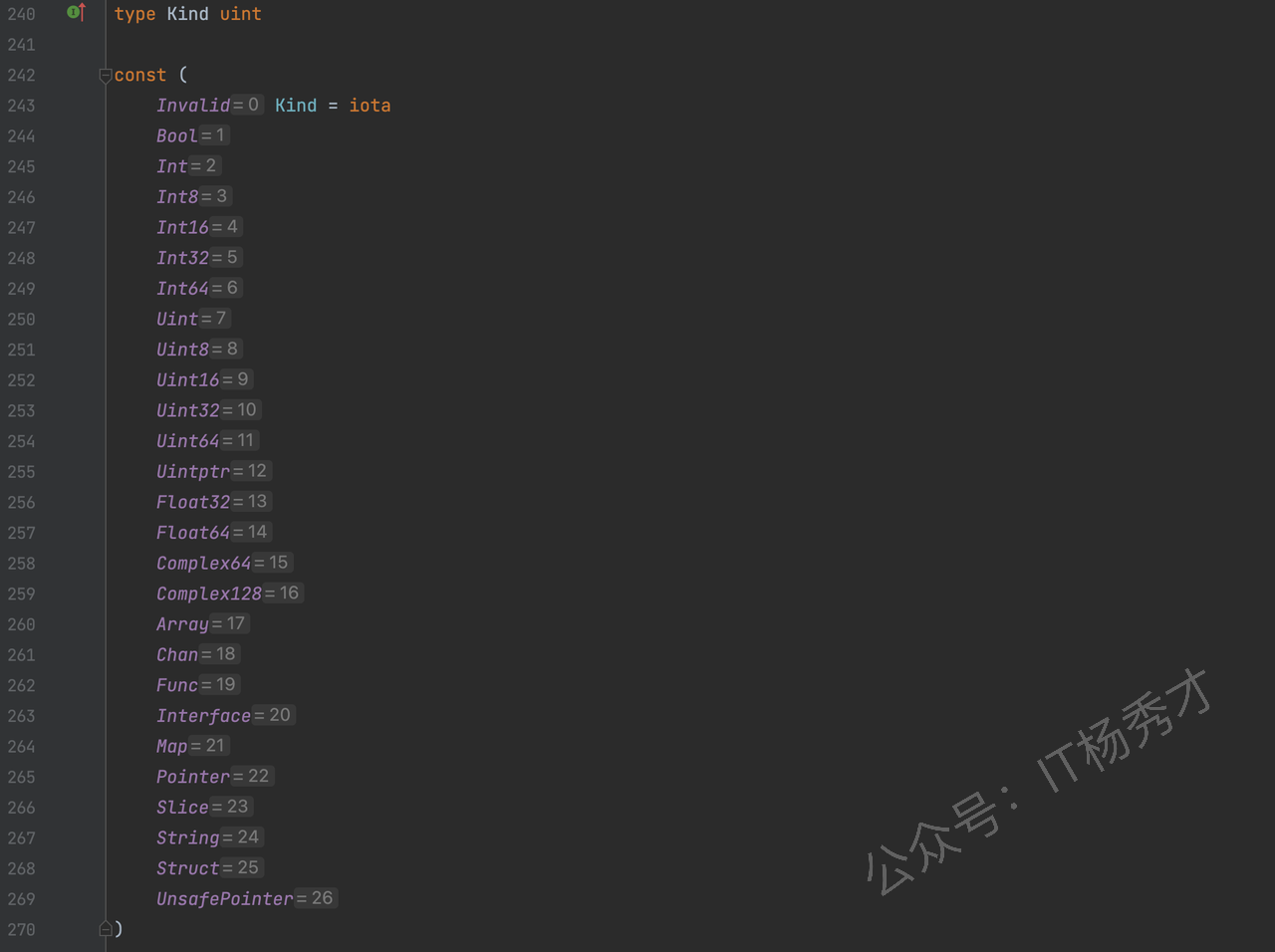
在Go语言中常用的数据类型有26种,以枚举的方式定义在`src/reflect/type.go`文件中:
|
||
|
||
|
||
|
||
这些类型中包含`int`,`bool`之类的基础数据类型,也包含`Struct`,`Array`,`Map`等复合类型,有了这些类型,我们用`type struct`自定义的任何类型都可以由他们组合完成。
|
||
看个`type struct`定义的数据类型使用反射的例子:
|
||
```go
|
||
package main
|
||
|
||
import (
|
||
"fmt"
|
||
"reflect"
|
||
)
|
||
|
||
type WrapInt int
|
||
|
||
func main() {
|
||
var num1 int = 100
|
||
var num2 WrapInt = 1000
|
||
|
||
num1 = int(num2) // 不同类型的type赋值,这里要强转
|
||
|
||
typeNum1 := reflect.TypeOf(num1)
|
||
fmt.Printf("type of num1 is %s\n", typeNum1.String())
|
||
|
||
typeNum2 := reflect.TypeOf(num2)
|
||
fmt.Printf("type of num2 is %s\n", typeNum2.String())
|
||
|
||
fmt.Printf("kind of num1 is %v\n", typeNum1.Kind())
|
||
fmt.Printf("kind of num2 is %v\n", typeNum2.Kind())
|
||
}
|
||
```
|
||
运行结果:
|
||
```
|
||
type of num1 is int
|
||
type of num2 is main.WrapInt
|
||
kind of num1 is int
|
||
kind of num2 is int
|
||
```
|
||
通过`WrapInt`的定义可以看到,`WrapInt`其实就是用`type`给`int`去了个别名,二者底层其实都是`int`类型,但是通过`reflect.TypeOf`获取到各自的`type`其实是不一样的,不同`type`之间的变量赋值是需要类型强制转换的,但是深层次的去分析`type`的种类,即`Kind`确是一样的。
|
||
|
||
## 反射使用
|
||
|
||
### 值对象
|
||
`reflect`包下跟值对象相关的常用函数或方法:
|
||
|
||
| 函数/方法 | 说明 |
|
||
|----------|------|
|
||
| `reflect.TypeOf()` | 获取某个对象的反射类型实现(`reflect.Type`) |
|
||
| `reflect.ValueOf()` | 获取某个对象的反射值对象(`reflect.Value`) |
|
||
| `reflect.Value.NumField()` | 获取结构体的反射值对象中的字段个数,只对结构体类型有效 |
|
||
| `reflect.Value.Field(i)` | 获取结构体的反射值对象中的第i个字段,只对结构体类型有效 |
|
||
| `reflect.Kind()` | 从反射值对象中获取该值的种类 |
|
||
| `reflect.Value.MapKeys()` | 对map的每个键的`reflect.Value`对象组成的一个切片 |
|
||
| `reflect.Value.MapIndex(i)` | 根据map的某个键的`reflect.Value`对象,返回值的`reflect.Value`对象 |
|
||
| `reflect.Value.Len()` | 对切片或数组的反射对象求切片或数组的长度 |
|
||
| `reflect.Value.Index(i)` | 返回切片或数组第i个元素的`reflect.Value`值 |
|
||
| `reflect.Int()/reflect.Uint()/reflect.String()/reflect.Bool()` | 从反射的值对象中取出对应值,注意`reflect.Int()/reflect.Uint()`方法对种类做了合并处理,它们只返回相应的最大范围的类型,`Int()`返回`Int64`类型,`Uint()`返回`Uint64`类型 |
|
||
|
||
#### 获取struct反射值
|
||
```go
|
||
package main
|
||
|
||
import (
|
||
"fmt"
|
||
"reflect"
|
||
)
|
||
|
||
type Student struct {
|
||
Name string
|
||
Age int
|
||
Score float64
|
||
}
|
||
|
||
func main() {
|
||
|
||
st := Student{
|
||
Name: "zhangsan",
|
||
Age: 18,
|
||
Score: 95.5,
|
||
}
|
||
v := reflect.ValueOf(st)
|
||
fmt.Printf("the field num of Student is %d\n", v.NumField())
|
||
fmt.Printf("field1 type is %v, value is %s\n", v.Field(0).Type().Name(), v.Field(0).String())
|
||
fmt.Printf("field2 type is %v, value is %d\n", v.Field(1).Type().Name(), v.Field(1).Int())
|
||
fmt.Printf("field2 type is %v, value is %f\n", v.Field(2).Type().Name(), v.Field(2).Float())
|
||
}
|
||
```
|
||
运行结果:
|
||
```
|
||
the field num of Student is 3
|
||
field1 type is string, value is zhangsan
|
||
field2 type is int, value is 18
|
||
field2 type is float64, value is 95.500000
|
||
```
|
||
`v := reflect.ValueOf(st)`,`v`是一个`Student`类型的反射值对象,通过`v.NumField()`可以得出`Student`类型的字段个数,然后`v.Field(i).Type().Name()`打印出各个字段值的类型,`v.Field(i)`打印出各个字段值
|
||
注意:`NumField()`和`Field()`方法只有原对象是结构体时才能调用,否则会panic
|
||
|
||
#### 获取map反射值
|
||
```go
|
||
package main
|
||
|
||
import (
|
||
"fmt"
|
||
"reflect"
|
||
)
|
||
|
||
func main() {
|
||
m := map[int]uint32{
|
||
1: 100,
|
||
2: 200,
|
||
}
|
||
v := reflect.ValueOf(m)
|
||
for _, k := range v.MapKeys() {
|
||
field := v.MapIndex(k)
|
||
fmt.Printf("key type is %v, key = %d; value type is %v, value = %d\n", k.Type().Name(), k.Int(), field.Type().Name(), field.Uint())
|
||
}
|
||
}
|
||
```
|
||
运行结果:
|
||
```
|
||
key type is int, key = 1; value type is uint32, value = 100
|
||
key type is int, key = 2; value type is uint32, value = 200
|
||
```
|
||
`v := reflect.ValueOf(m)`对map类型的对象m进行反射,通过`v.MapKeys()`的到m中所有key的`reflect.Value`对象k,然后通过`v.MapIndex(k)`的到对应key反射值对象的value反射值对象,然后通过`reflect.Value`的`Type().Name()`方法获取map中key,value的类型,然后打印出对应值
|
||
|
||
#### 获取slice反射值
|
||
```go
|
||
|
||
import (
|
||
"fmt"
|
||
"reflect"
|
||
)
|
||
|
||
func main() {
|
||
slice := []int{1, 2, 3}
|
||
v1 := reflect.ValueOf(slice)
|
||
for i := 0; i < v1.Len(); i++ {
|
||
elem := v1.Index(i)
|
||
fmt.Printf("%v ", elem.Interface())
|
||
}
|
||
|
||
fmt.Println()
|
||
|
||
nums := [3]int{4, 5, 6}
|
||
v2 := reflect.ValueOf(nums)
|
||
for i := 0; i < v2.Len(); i++ {
|
||
elem := v2.Index(i)
|
||
fmt.Printf("%v ", elem.Interface())
|
||
}
|
||
}
|
||
```
|
||
运行结果:
|
||
```
|
||
1 2 3
|
||
4 5 6
|
||
```
|
||
`v1`,`v2`分别是切片和数组的反射值对象,通过`Len()`获取到数组或切片中的元素个数,然后通过`v.Index(i)`获取对应元素的`reflect.value`对象,打印出其值
|
||
> **注意:`Len()`和`Index(i)`方法只能在原对象是切片,数组或字符串时才能调用,其他类型会panic**。
|
||
|
||
### 类型对象
|
||
reflect包下跟类型相关的常用函数或方法
|
||
|
||
| 函数/方法 | 说明 |
|
||
|----------|------|
|
||
| `reflect.Value.NumField()` | 获取结构体的反射值对象中的字段个数,只对结构体类型有效 |
|
||
| `reflect.Value.Field(i)` | 获取结构体的反射值对象中的第i个字段,只对结构体类型有效 |
|
||
| `reflect.Value.Elem()` | 根据指针获取对应的具体类型 |
|
||
| `reflect.Value.NumIn()` | 获取函数反射类型的参数个数 |
|
||
| `reflect.Value.In(i)` | 获取函数反射类型的第i个参数 |
|
||
| `reflect.Value.NumOut()` | 获取函数反射类型的返回值个数 |
|
||
| `reflect.Value.Out(i)` | 获取函数反射类型的第i个返回值 |
|
||
| `reflect.Value.NumMethod()` | 获取struct上绑定的方法个数 |
|
||
| `reflect.Value.Method(i)` | 获取struct上绑定的第i个方法 |
|
||
|
||
#### struct反射类型
|
||
```go
|
||
package main
|
||
|
||
import (
|
||
"fmt"
|
||
"reflect"
|
||
)
|
||
|
||
type Student struct {
|
||
Name string
|
||
Age int
|
||
Score float64
|
||
}
|
||
|
||
func main() {
|
||
st := Student{
|
||
Name: "zhangsan",
|
||
Age: 18,
|
||
Score: 90.5,
|
||
}
|
||
t := reflect.TypeOf(st)
|
||
fmt.Println(t.Name())
|
||
fmt.Println(t.Kind())
|
||
fmt.Println(t.NumField())
|
||
for i := 0; i < t.NumField(); i++ {
|
||
fmt.Printf("field1 name is %s, field1 type is %s\n", t.Field(i).Name, t.Field(i).Type.String())
|
||
}
|
||
}
|
||
```
|
||
运行结果:
|
||
```
|
||
Student
|
||
struct
|
||
3
|
||
field1 name is Name, field1 type is string
|
||
```
|
||
通过`reflect.Type`的`Name()`方法可以获取对应的`Type`类型,`Kind()`方法获取底层的数据种类,即`kind`,跟`reflect.Value`一样,`reflect.Type`也提供了`NumField()`方法用于获取结构体对象中的字段个数,通过`t.Field(i).Name`可以获取对应字段的名字。同样,`Field(i)`和`NumField()`也只能对结构体反射使用
|
||
|
||
#### 指针反射类型
|
||
```go
|
||
package main
|
||
|
||
import (
|
||
"fmt"
|
||
"reflect"
|
||
)
|
||
|
||
type Student struct {
|
||
Name string
|
||
Age int
|
||
Score float64
|
||
}
|
||
|
||
func main() {
|
||
st := &Student{
|
||
Name: "zhangsan",
|
||
Age: 18,
|
||
Score: 90.5,
|
||
}
|
||
t := reflect.TypeOf(st)
|
||
|
||
fmt.Println(t.Kind())
|
||
fmt.Println(t.Elem().Name()) // 这里一定要加Elem(),根据指针获取到具体类型后,才能或者具体的type名
|
||
fmt.Println(t.Elem().NumField()) // 这里一定要加Elem(),根据指针获取到具体类型后,才能字段个数
|
||
for i := 0; i < t.Elem().NumField(); i++ {
|
||
fmt.Printf("field1 name is %s, field1 type is %s\n", t.Elem().Field(i).Name, t.Elem().Field(i).Type.String())
|
||
}
|
||
|
||
}
|
||
```
|
||
运行结果:
|
||
```
|
||
ptr
|
||
Student
|
||
3
|
||
field1 name is Name, field1 type is string
|
||
field2 name is Age, field2 type is int
|
||
field3 name is Score, field3 type is float64
|
||
```
|
||
可以看到,跟上面直接获取`struct`有一点点小小的区别,那就是`fmt.Println(t.Kind())`打印出的是一个`ptr`指针类型,而不再是`struct`类型,正是因为这里是一个`ptr`,所以我们不能直接在这个`ptr`上调用.Name()以及其他的.NumField()之类的方法,要根据`ptr`的.Elem()获取到具体类型之后,才能用这些方法,否则程序就回报`panic`,这点一定要注意
|
||
|
||
#### 函数反射类型
|
||
```go
|
||
package main
|
||
|
||
import (
|
||
"fmt"
|
||
"reflect"
|
||
)
|
||
|
||
func Add(num1, num2 int) (int, error) {
|
||
return num1 + num2, nil
|
||
}
|
||
|
||
func main() {
|
||
|
||
fmt.Println("input:")
|
||
t := reflect.TypeOf(Add)
|
||
for i := 0; i < t.NumIn(); i++ {
|
||
tIn := t.In(i)
|
||
fmt.Print(tIn.Name())
|
||
fmt.Printf(" ")
|
||
}
|
||
fmt.Printf("\n--------------------------------")
|
||
|
||
fmt.Println("output:")
|
||
for i := 0; i < t.NumOut(); i++ {
|
||
tOut := t.Out(i)
|
||
fmt.Print(tOut.Name())
|
||
fmt.Print(" ")
|
||
}
|
||
|
||
}
|
||
```
|
||
运行结果:
|
||
```
|
||
input:
|
||
int int
|
||
--------------------------------
|
||
output:
|
||
int error
|
||
```
|
||
`t := reflect.TypeOf(Add)`获取到Add函数的`type`类型,然后通过`NumIn()`方法获得Add函数的参数个数,依次打印出参数的类型。通过`NumOut()`方法获得Add函数的返回值个数,依次打印出返回值的类型
|
||
|
||
#### 3.2.4 反射获取struct方法
|
||
```go
|
||
package main
|
||
|
||
import (
|
||
"fmt"
|
||
"reflect"
|
||
)
|
||
|
||
type Student struct {
|
||
Name string
|
||
Age int
|
||
Score float64
|
||
}
|
||
|
||
func (s *Student) GetName() string {
|
||
return s.Name
|
||
}
|
||
|
||
func (s *Student) SetName(name string) {
|
||
s.Name = name
|
||
}
|
||
|
||
func (s *Student) GetAge() int {
|
||
return s.Age
|
||
}
|
||
|
||
func (s *Student) SetAge(age int) {
|
||
s.Age = age
|
||
}
|
||
|
||
func (s *Student) GetScore() float64 {
|
||
return s.Score
|
||
}
|
||
|
||
func (s *Student) SetScore(score float64) {
|
||
s.Score = score
|
||
}
|
||
|
||
func main() {
|
||
st := &Student{
|
||
Name: "zhangsan",
|
||
Age: 18,
|
||
Score: 90.5,
|
||
}
|
||
t := reflect.TypeOf(st)
|
||
|
||
for i := 0; i < t.NumMethod(); i++ {
|
||
m := t.Method(i)
|
||
fmt.Printf("%+v\n", m)
|
||
}
|
||
}
|
||
```
|
||
运行结果:
|
||
```
|
||
{GetName func(*main.Student) string}
|
||
{SetName func(*main.Student, string)}
|
||
{GetAge func(*main.Student) int}
|
||
{SetAge func(*main.Student, int)}
|
||
{GetScore func(*main.Student) float64}
|
||
{SetScore func(*main.Student, float64)}
|
||
```
|
||
- `reflect.Type.NumMethod()`:返回struct所绑定的的方法个数
|
||
- `reflect.Type.Method(i)`:返回第i个方法的`reflect.Method`对象
|
||
|
||
`reflect.Method`定义在`src/reflect/type.go`文件:
|
||
```go
|
||
type Method struct {
|
||
Name string // 方法名
|
||
PkgPath string
|
||
Type Type // 方法类型(
|
||
Func Value // 方法值(方法的接收器作为第一个参数)
|
||
Index int // 是结构体中的第几个方法
|
||
}
|
||
```
|
||
所以,通过`reflect.Method`对象,我们可以获取到`struct`所绑定的对应方法的方法名,方法类型等信息
|
||
|
||
### 通过反射调用方法
|
||
在上一小节我们知道了`reflect.Type.Method(i)`可以获取到`struct`所绑定的具体的方法对象`reflect.Method`,通过这个对象,我们不仅可以获取方法的详细信息,还可以动态的调用方法。
|
||
其实在`reflect.Value`里我们也可以使用`NumMethod()`/`Method(i)`方法获取到对应的方法信息,不同的是`reflect.Value.Method(i)`返回的使一个`reflect.Value`对象,但是同样可以根据这个对象来动态调用方法,只是两者调用方法的方式有所区别
|
||
请看具体例子:
|
||
```go
|
||
package main
|
||
|
||
import (
|
||
"fmt"
|
||
"reflect"
|
||
)
|
||
|
||
type Student struct {
|
||
Name string
|
||
Age int
|
||
Score float64
|
||
}
|
||
|
||
func (s *Student) GetName() string {
|
||
return s.Name
|
||
}
|
||
|
||
func (s *Student) SetName(name string) {
|
||
s.Name = name
|
||
}
|
||
|
||
func (s *Student) GetAge() int {
|
||
return s.Age
|
||
}
|
||
|
||
func (s *Student) SetAge(age int) {
|
||
s.Age = age
|
||
}
|
||
|
||
func (s *Student) GetScore() float64 {
|
||
return s.Score
|
||
}
|
||
|
||
func (s *Student) SetScore(score float64) {
|
||
s.Score = score
|
||
}
|
||
|
||
func main() {
|
||
st := &Student{
|
||
Name: "zhangsan",
|
||
Age: 18,
|
||
Score: 90.5,
|
||
}
|
||
fmt.Printf("st === %+v\n", st)
|
||
|
||
t := reflect.TypeOf(st)
|
||
v := reflect.ValueOf(st)
|
||
|
||
m1, ok := t.MethodByName("SetName") // 获取SetName方法
|
||
fmt.Printf("t get func by name:%t\n", ok)
|
||
|
||
argsV1 := make([]reflect.Value, 0)
|
||
argsV1 = append(argsV1, v)
|
||
argsV1 = append(argsV1, reflect.ValueOf("lisi"))
|
||
m1.Func.Call(argsV1) //
|
||
fmt.Printf("st === %+v\n", st)
|
||
|
||
m2 := v.MethodByName("SetName") // 获取SetName方法
|
||
argsV2 := make([]reflect.Value, 0)
|
||
argsV2 = append(argsV2, reflect.ValueOf("wangwu"))
|
||
m2.Call(argsV2)
|
||
fmt.Printf("st === %+v\n", st)
|
||
}
|
||
```
|
||
运行结果:
|
||
```
|
||
st === &{Name:zhangsan Age:18 Score:90.5}
|
||
t get func by name:true
|
||
st === &{Name:lisi Age:18 Score:90.5}
|
||
st === &{Name:wangwu Age:18 Score:90.5}
|
||
```
|
||
可以看到通过`reflect.Type.MethodByName()`方法获取到的`reflect.Method`对象和`reflect.Value.MethodByName()`方法获取到的`reflect.Method`获取到的`reflect.Value`对象都可以在程序运行时动态的调用方法修改结构本身,`student`的`name`由`zhangsan`------>`lisi`------>`wangwu`。
|
||
但是二者的调用存在一个区别:通过`reflect.Method`调用方法,必须使用`Func`字段,而且要传入接收器的`reflect.Value`作为第一个参数
|
||
```go
|
||
m1.Func.Call(argsV1)
|
||
```
|
||
`reflect.Value.MethodByName()`返回一个`reflect.Value`对象,它不需要接收器的`reflect.Value`作为第一个参数,而且直接使用`Call()`发起方法调用:
|
||
```go
|
||
m2.Call(argsV2)
|
||
```
|
||
|
||
### 通过反射设置值
|
||
在介绍通过反射设置或者说是修改值的方法之前,首先介绍一个概念,反射寻址。简单的说,可寻址就是可以根据地址找到值,在反射里面,`reflect.Value`由`reflect.ValueOf()`方法得到,根据命名就可以知道`reflect.ValueOf()`是得到一个值对象,显然他不能得到这个值的地址。所以通过`reflect.ValueOf()`方法得到的`reflect.Value`都是不可寻址的。在`reflect`包下有一个`CanAddr()`方法可以用于验证一个对象是否可寻址
|
||
```go
|
||
package main
|
||
|
||
import (
|
||
"fmt"
|
||
"reflect"
|
||
)
|
||
|
||
type Student struct {
|
||
Name string
|
||
Age int
|
||
Score float64
|
||
}
|
||
|
||
func main() {
|
||
st := &Student{
|
||
Name: "zhangsan",
|
||
Age: 18,
|
||
Score: 90.5,
|
||
}
|
||
v := reflect.ValueOf(st)
|
||
fmt.Println(v.CanAddr())
|
||
}
|
||
```
|
||
运行结果:
|
||
```
|
||
false
|
||
```
|
||
尽管这里`st`是一个`Student`类型的指针,但是经过`reflect.ValueOf()`之后得到的对象`v`,仍然是不能寻址的,他只能反映出当前指针指向的具体元素的地址,而当前指针自身所在的内存地址是无从得知的
|
||
经过前面学习指针反射类型的学习,我们知道了假设`reflect.ValueOf()`返回的是一个指针的`reflect.Value`对象,那么我们可以调用`reflect.Value.Elem()`方法得到具体的类型,而此时得到的这个反射具体类型就是可寻址的,我们可以知道他的地址,道理很简单,因为`reflect.Value.Elem()`获取到的值,记录了根据指针获取到值这个获取路径,显然我们可以根据值追溯到地址
|
||
|
||
1. reflect.Value.Elem()方法得到具体的类型可寻址
|
||
```go
|
||
package main
|
||
|
||
import (
|
||
"fmt"
|
||
"reflect"
|
||
)
|
||
|
||
type Student struct {
|
||
Name string
|
||
Age int
|
||
Score float64
|
||
}
|
||
|
||
func main() {
|
||
st := &Student{
|
||
Name: "zhangsan",
|
||
Age: 18,
|
||
Score: 90.5,
|
||
}
|
||
v := reflect.ValueOf(st)
|
||
fmt.Println(v.Elem().CanAddr())
|
||
}
|
||
```
|
||
运行结果:
|
||
```
|
||
true
|
||
```
|
||
可以看到,通过`reflect.Value.Elem()`方法得到具体的类型之后,这个具体的类型就是可寻址的,所以`CanAddr()`方法返回`true`
|
||
|
||
2. 对切片进行反射时,通过reflect.Value.Index(i)获取到的reflect.Value对象是可以寻址的
|
||
```go
|
||
package main
|
||
|
||
import (
|
||
"fmt"
|
||
"reflect"
|
||
)
|
||
|
||
type Student struct {
|
||
Name string
|
||
Age int
|
||
Score float64
|
||
}
|
||
|
||
func main() {
|
||
slice := []int{1, 2, 3, 4, 5}
|
||
v := reflect.ValueOf(slice)
|
||
fmt.Println(v.Index(0).CanAddr())
|
||
fmt.Println(v.Index(1).CanAddr())
|
||
}
|
||
```
|
||
运行结果:
|
||
```
|
||
true
|
||
true
|
||
```
|
||
可以看到,通过`reflect.Value.Index(i)`获取到的`reflect.Value`对象是可以寻址的,所以`CanAddr()`方法返回`true`。但是对数组`reflect.Value.Index(i)`获取到的`reflect.Value`对象是不可寻址的
|
||
```go
|
||
package main
|
||
|
||
import (
|
||
"fmt"
|
||
"reflect"
|
||
)
|
||
|
||
type Student struct {
|
||
Name string
|
||
Age int
|
||
Score float64
|
||
}
|
||
|
||
func main() {
|
||
nums := [3]int{1, 2, 3}
|
||
v1 := reflect.ValueOf(nums)
|
||
fmt.Println(v1.Index(0).CanAddr())
|
||
}
|
||
```
|
||
运行结果:
|
||
```
|
||
false
|
||
```
|
||
可以看到,对数组`reflect.Value.Index(i)`获取到的`reflect.Value`对象是不可寻址的
|
||
通过`reflect.ValueOf`的到的其实是原始数据的一份拷贝,切片底层实现其实是一个`stuct`类型,`struct`里包含一个执行具体数组的指针,对切片拷贝,虽然拷贝了这个`struct`,自然`struct`里的指针也拷贝了一份,但是两个指针执行同一个内存区域,所以修改拷贝的切片,也会影响原值
|
||
|
||
3. 通过结构体的指针获取到的字段也是可寻址的
|
||
```go
|
||
package main
|
||
|
||
import (
|
||
"fmt"
|
||
"reflect"
|
||
)
|
||
|
||
type Student struct {
|
||
Name string
|
||
Age int
|
||
Score float64
|
||
}
|
||
|
||
func main() {
|
||
st := &Student{
|
||
Name: "zhangsan",
|
||
Age: 18,
|
||
Score: 90.5,
|
||
}
|
||
v := reflect.ValueOf(st)
|
||
f := v.Elem().Field(0)
|
||
fmt.Println(f.CanAddr())
|
||
}
|
||
```
|
||
运行结果:
|
||
```
|
||
true
|
||
```
|
||
可以看到,通过结构体的指针获取到的字段也是可寻址的。通过上面分析,可寻址就是可以找到数据本身,而不是找到数据的副本,既然我们找到了数据本身,那么就可以对原数据修改,即设置值了吗?
|
||
大体上是这样,但是条件可能还要更严格一些,刚是可寻址还不够,比如当`struct`里含有未导出字段时,这个未导出字段时不可设置的。所以,在`reflect`包下有一个专门的方法用于判断这个值是否可修改:`CanSet()`
|
||
假设我们将`Student`的`score`字段改为未导出的,然后运行以下代码:
|
||
```go
|
||
package main
|
||
|
||
import (
|
||
"fmt"
|
||
"reflect"
|
||
)
|
||
|
||
type Student struct {
|
||
Name string
|
||
Age int
|
||
score float64
|
||
}
|
||
|
||
func main() {
|
||
st := &Student{
|
||
Name: "zhangsan",
|
||
Age: 18,
|
||
score: 90.5,
|
||
}
|
||
v := reflect.ValueOf(st)
|
||
f := v.Elem().Field(0)
|
||
fmt.Println(f.CanSet())
|
||
f2 := v.Elem().Field(2)
|
||
fmt.Println(f2.CanSet())
|
||
}
|
||
```
|
||
运行结果:
|
||
```
|
||
true
|
||
false
|
||
```
|
||
可以看到,可导出字段`Name`是可设置的,而不可导出字段`score`是不可设置的。当我们判定一个值是可设置之后,接下来要怎么修改这个值呢?
|
||
`reflect.Value`为基础类型提供了一系列特殊的`Set`方法:`SetInt`、`SetUint`、`SetFloat`等在反射的时候修改对应类型值。
|
||
下面看个具体例子:
|
||
```go
|
||
package main
|
||
|
||
import (
|
||
"fmt"
|
||
"reflect"
|
||
)
|
||
|
||
type Student struct {
|
||
Name string
|
||
Age int
|
||
Score float64
|
||
}
|
||
|
||
func main() {
|
||
st := &Student{
|
||
Name: "zhangsan",
|
||
Age: 18,
|
||
Score: 90.5,
|
||
}
|
||
v := reflect.ValueOf(st)
|
||
f := v.Elem().Field(0)
|
||
f.SetString("lisi")
|
||
fmt.Printf("st = %+v\n", st)
|
||
}
|
||
```
|
||
运行结果:
|
||
```
|
||
st = &{Name:lisi Age:18 Score:90.5}
|
||
```
|
||
可以看到,通过调用第一个字段`reflect.value`的`SetString`方法,将`st`对象的`Name`改为了`lisi`。
|
||
|
||
## 结构体标签
|
||
|
||
|
||
当我们判定一个值是可设置之后,接下来要怎么修改这个值呢?
|
||
|
||
`reflect.Value`为基础类型提供了一系列特殊的`Set`方法:`SetInt`、`SetUint`、`SetFloat`等在反射的时候修改对应类型值。
|
||
|
||
下面看个具体例子:
|
||
|
||
```go
|
||
package main
|
||
|
||
import (
|
||
"fmt"
|
||
"reflect"
|
||
)
|
||
|
||
type Student struct {
|
||
Name string
|
||
Age int
|
||
Score float64
|
||
}
|
||
|
||
func main() {
|
||
st := &Student{
|
||
Name: "zhangsan",
|
||
Age: 18,
|
||
Score: 90.5,
|
||
}
|
||
v := reflect.ValueOf(st)
|
||
f := v.Elem().Field(0)
|
||
f.SetString("lisi")
|
||
fmt.Printf("st = %+v\n", st)
|
||
}
|
||
```
|
||
|
||
运行结果:
|
||
```
|
||
st = &{Name:lisi Age:18 Score:90.5}
|
||
```
|
||
|
||
可以看到,通过调用第一个字段`reflect.value`的`SetString`方法,将`st`对象的`Name`改为了`lisi`。
|
||
|
||
### 结构体标签
|
||
我们在定义结构体的时候,可以为每个字段后面加一个标签,即`StructTag`,标签其实就是一组键值对,每个键值对用空格分开,这些标签信息可以通过反射获取:
|
||
```go
|
||
package main
|
||
|
||
import (
|
||
"fmt"
|
||
"reflect"
|
||
)
|
||
|
||
type Student struct {
|
||
Name string `json:"name"`
|
||
Age int `json:"age"`
|
||
Score float64 `json:"score"`
|
||
}
|
||
|
||
func main() {
|
||
st := &Student{
|
||
Name: "zhangsan",
|
||
Age: 18,
|
||
Score: 90.5,
|
||
}
|
||
t := reflect.TypeOf(st).Elem()
|
||
for i := 0; i < t.NumField(); i++ {
|
||
f := t.Field(i)
|
||
fmt.Println(f.Tag)
|
||
}
|
||
}
|
||
```
|
||
运行结果:
|
||
```
|
||
json:"name"
|
||
json:"age"
|
||
json:"score"
|
||
```
|
||
|
||
## 反射的优缺点
|
||
优点:
|
||
- 可以提升程序代码的灵活性,根据条件在程序运行时灵活的调用函数,并且修改源代码结构
|
||
|
||
缺点:
|
||
- 主要是性能影响,反射过程中会有大量的内存开辟和gc过程,导致程序的性能降低
|