
841 lines
37 KiB
Markdown
841 lines
37 KiB
Markdown
---
|
||
tags:
|
||
- Go
|
||
- golang
|
||
- go原理深入
|
||
- map原理
|
||
---
|
||
|
||
# map原理
|
||
|
||
## map是什么
|
||
|
||
map就是一个key/value键值对的集合,可以根据key在O(1)的时间复杂度内取到value,有点类似与我们常用的数组或者切片结构,可以把数组看作是一种特殊的map,数组的key为数组的下标,而map的key可以为任意的可比较结构。在map中key不允许重复且要能够比较。
|
||
|
||
在go语言中,map的底层采用hash表,用变种拉链法来解决hash冲突问题。
|
||
|
||
## 哈希冲突
|
||
|
||
哈希表的原理是将多个k-v键值对散列的存储在buckets中,buckets可以理解为一个连续的数组,所以给定一个key/value键值对,我们要将其存储到合适的位置需要经过两步骤:
|
||
|
||
1. 计算hash值:`hash = hashFunc(key)`
|
||
|
||
2. 计算索引位置: `index = hash % len(buckets)`
|
||
|
||
第一步是根据hash函数将key转化为一个hash值
|
||
|
||
第二步用hash值对 桶的数量 取模得到一个索引值,这样就得到了我们要插入的键值对的位置。
|
||
|
||
但是这里会出现一个问题,比如我们有两个键值对`key1/value1`和`key2/value2`,经过哈希函数 hashFunc的计算得到的哈希值`hash1`和`hash2`相同,那么这两个hash值的索引也必然相同,那将会存放到同一个位置,那这样怎么处理呢?丢弃后来的键值对?或者是覆盖之前的键值对?
|
||
|
||
但是这都是不可取的,因为`key1`和`key2`是不同的。他们就是两个不同的键值对,理论上都应该被存储,那应该怎么存储呢?这就是我们所说的哈希碰撞问题。
|
||
|
||
解决哈希碰撞一般有两种方式;拉链法和开放寻址法
|
||
|
||
### 拉链法
|
||
|
||
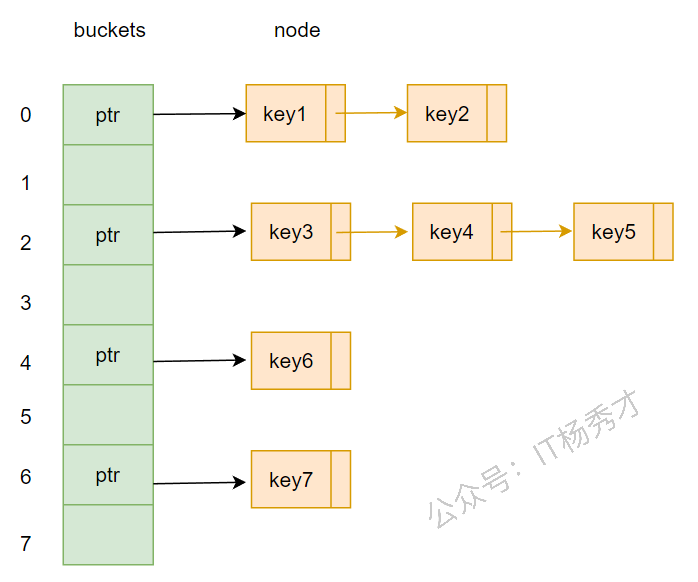
拉链法是一种最常见的解决哈希冲突的方法,很多语言都是用拉链法哈希冲突。拉链法的主要实现是底层不直接使用连续数组来直接存储数据元素,而是使用通过数组和链表组合连使用,数组里存储的其实是一个指针,指向一个链表。当出现两个`key`比如`key1`和`key2`的哈希值相同的情况,就将数据链接到链表上,如果没有发现有冲突的`key`,显然链表上就只有一个元素。拉链法处理冲突简单,可以动态的申请内存,删除增加节点都很方便,当冲突严重,链表长度过长的时候也⽀持更多的优化策略,**⽐如⽤红⿊树代替链表。**
|
||
|
||
拉链法结构如下图:
|
||
|
||
|
||
|
||
左边为一个连续数组,数组每个元素存储一个指针,指向一个链表,链表里每个节点存储的是发生hash冲突的数据
|
||
|
||
### 开放地址法
|
||
|
||
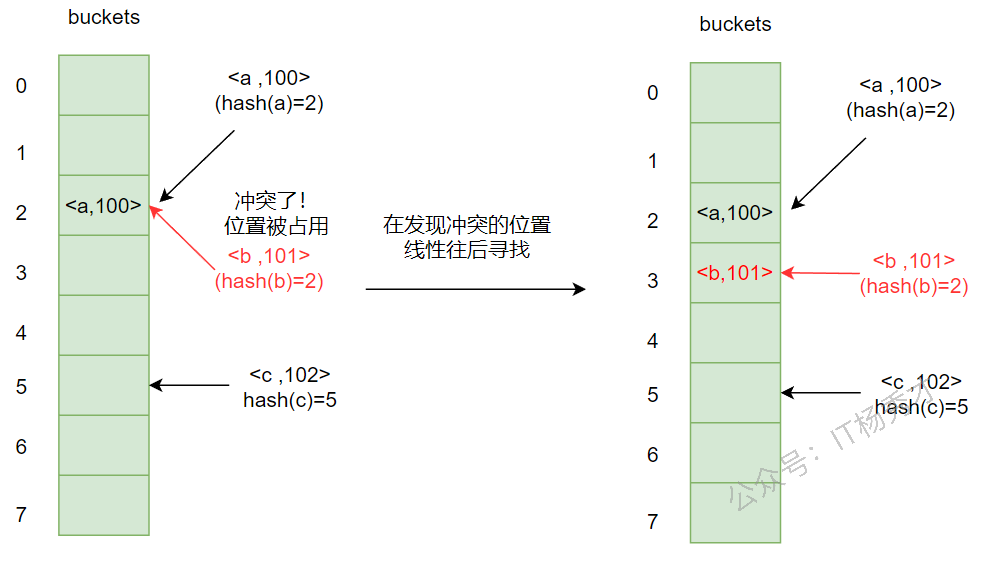
开放地址法是另外一种非常常用的解决哈希冲突的策略,与拉链法不同,开放地址法是将具体的数据元素存储在数组桶中,在要插入新元素时,先根据哈希函数算出hash值,根据hash值计算索引,如果发现冲突了,计算出的数组索引位置已经有数据了,就继续向后探测,直到找到未使用的数据槽为止。哈希函数可以简单地理解为:
|
||
|
||
`hash(key)=(hash1(key)+i)%len(buckets)`
|
||
|
||
开放地址法结构如下图
|
||
|
||
|
||
|
||
在存储键值对`<b,101>`的时候,经过hash计算,发现原本应该存放在数组下标为2的位置已经有值了,存放了`<a,100>`,就继续向后探测,发现数组下标为3的位置是空槽,未被使用,就将`<b,101>`存放在这个位置。
|
||
|
||
## go语言map的底层结构
|
||
|
||
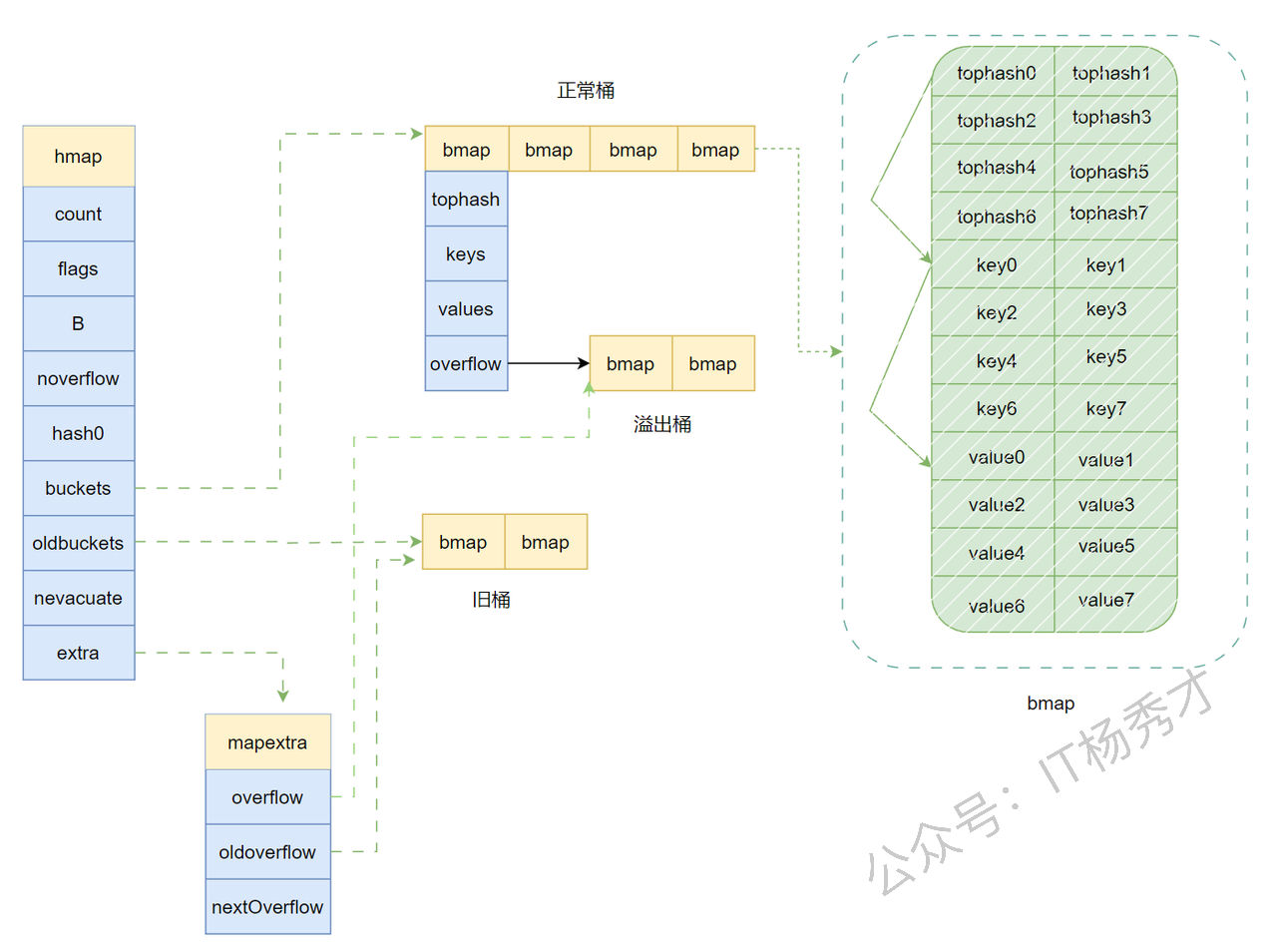
go语言中的map其实就是一个指向`hmap`的指针,占用8个字节。所以map底层结构就是`hmap`,`hmap`包含多个结构为`bmap`的`bucket`数组,当发生冲突的时候,会到正常桶里面的overflow指针所指向的溢出桶里面去找,Go语言中溢出桶也是一个动态数组形式,它是根据需要动态创建的。Go语言中处理冲突其实是采用了优化的拉链法,链表中每个节点存储的不是一个键值对,而是8个键值对。其整体的结构如下图:
|
||
|
||
|
||
|
||
看一下hmap的结构体定义:
|
||
|
||
```go
|
||
// A header for a Go map.
|
||
type hmap struct {
|
||
// Note: the format of the hmap is also encoded in cmd/compile/internal/reflectdata/reflect.go.
|
||
// Make sure this stays in sync with the compiler's definition.
|
||
count int // ## live cells == size of map. Must be first (used by len() builtin)
|
||
flags uint8
|
||
B uint8 // log_2 of ## of buckets (can hold up to loadFactor * 2^B items)
|
||
noverflow uint16 // approximate number of overflow buckets; see incrnoverflow for details
|
||
hash0 uint32 // hash seed
|
||
|
||
buckets unsafe.Pointer // array of 2^B Buckets. may be nil if count==0.
|
||
oldbuckets unsafe.Pointer // previous bucket array of half the size, non-nil only when growing
|
||
nevacuate uintptr // progress counter for evacuation (buckets less than this have been evacuated)
|
||
|
||
extra *mapextra // optional fields
|
||
}
|
||
```
|
||
|
||
字段含义:
|
||
|
||
| 字段 | 释义 |
|
||
| ----------- | ------------------------------------------------------------------------------------ |
|
||
| count | map中元素个数,对应于len(map)的值 |
|
||
| flags | 状态标志位,标记map的一些状态 |
|
||
| B | 桶数以2为底的对数,即B=log\_2(len(buckets)),比如B=3,那么桶数为2^3=8 |
|
||
| noverflow | 溢出桶数量近似值 |
|
||
| hash0 | 哈希种子 |
|
||
| buckets | 指向buckets数组的指针,buckets数组的元素为bmap,如果数组元素个数为0,其值为nil |
|
||
| oldbuckets | 是一个指向buckets数组的指针,在扩容时,oldbuckets 指向老的buckets数组(大小为新buckets数组的一半),非扩容时,oldbuckets 为空 |
|
||
| nevacuate | 表示扩容进度的一个计数器,小于该值的桶已经完成迁移 |
|
||
| extra | 指向mapextra 结构的指针,mapextra 存储map中的溢出桶 |
|
||
|
||
mapextra 结构定义如下:
|
||
|
||
```go
|
||
// mapextra holds fields that are not present on all maps.
|
||
type mapextra struct {
|
||
// If both key and elem do not contain pointers and are inline, then we mark bucket
|
||
// type as containing no pointers. This avoids scanning such maps.
|
||
// However, bmap.overflow is a pointer. In order to keep overflow buckets
|
||
// alive, we store pointers to all overflow buckets in hmap.extra.overflow and hmap.extra.oldoverflow.
|
||
// overflow and oldoverflow are only used if key and elem do not contain pointers.
|
||
// overflow contains overflow buckets for hmap.buckets.
|
||
// oldoverflow contains overflow buckets for hmap.oldbuckets.
|
||
// The indirection allows to store a pointer to the slice in hiter.
|
||
overflow *[]*bmap
|
||
oldoverflow *[]*bmap
|
||
|
||
// nextOverflow holds a pointer to a free overflow bucket.
|
||
nextOverflow *bmap
|
||
}
|
||
```
|
||
|
||
| 字段 | 释义 |
|
||
| ------------- | ---------- |
|
||
| overflow | 溢出桶链表地址 |
|
||
| oldoverflow | 老的溢出桶链表地址 |
|
||
| nextOverflow | 下一个空闲溢出桶地址 |
|
||
|
||
`hmap`中真正用于存储数据的是`buckets`指向的这个`bmap`(桶)数组,每一个 `bmap` 都能存储 8 个键值对,当map中的数据过多,`bmap`数组存不下的时候就会存储到extra指向的溢出bucket(桶)里面
|
||
|
||
下面看一下bmap的结构定义:
|
||
|
||
```go
|
||
type bmap struct {
|
||
topbits [8]uint8
|
||
keys [8]keytype
|
||
values [8]valuetype
|
||
overflow uintptr
|
||
}
|
||
```
|
||
|
||
| 字段 | 释义 |
|
||
| ----------- | ------------------------------------------------- |
|
||
| topbits | 存储了bmap里8个key/value键值对的每个key根据哈希函数计算出的hash值的高 8 位 |
|
||
| keys | 存储了bmap里8个key/value键值对的key |
|
||
| values | 存储了bmap里8个key/value键值对的value |
|
||
| overflow | 指向溢出桶的指针 |
|
||
|
||
再解释一下这个`tophash`,go语言的`map`会根据每一个key计算出一个`hash`值,有意思的是,对这个`hash`值的使用,go语言并不是一次性使用的,而是分开使用的,在使用中,把求得的这个`hash`值按照用途一分为二:高位和低位
|
||
|
||

|
||
|
||
假设我们对一个`key`做`hash`计算得到了一个hash值如图所示,蓝色就是这个hash值的高8位,红色就是这个hash值的低8位。而每个bmap中其实存储的就是8个这个蓝色的数字。
|
||
|
||
通过上图map的底层结构图我们可以看到,bmap的结构,bmap显示存储了8个`tohash`值,然后存储了8个键值对,注意,这8个键值对并不是按照`key/value`这样`key`和`value`放在一起存储的,而是先连续存完8个`key`,之后再连续存储8个`value`这样,当键值对不够8个时,对应位置就留空。这样存储的好处是可以消除字节对齐带来的空间浪费。
|
||
|
||
### map的访问原理
|
||
|
||
对map的访问有两种方式:
|
||
|
||
```go
|
||
v := map[key] // 当map中没有对应的key时,会返回value对应类型的零值
|
||
v, ok := map[key] // 当map中没有对应的key时,除了会返回value对应类型的零值,还会返回一个值存不存在的布尔值
|
||
```
|
||
|
||
虽然这两种方法在返回值上很接近,后者只是多出了一个key存不存在的布尔值,但是在运行时调用的方法却不一样。
|
||
|
||
源码链接:[ Map 源码梳理](https://ls8sck0zrg.feishu.cn/docx/XJfDdQ6pgoYIjqxzgpJcFycTn1d##YHtod9JyPoVyNbxrbKhc78m9nCm)&##x20;
|
||
|
||
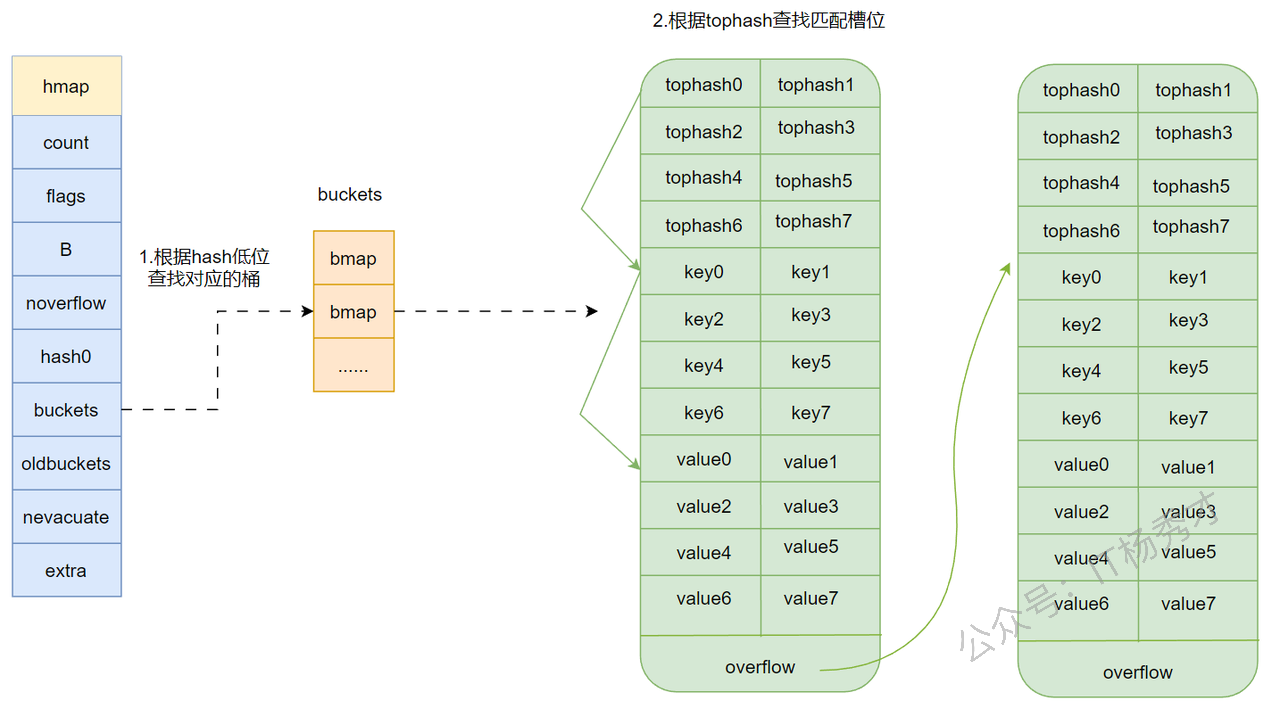
大致原理如下图所示:
|
||
|
||
|
||
|
||
这里梳理一下步骤:
|
||
|
||
1. 判断map是否为空或者无数据,若为空或者无数据返回对应的空值
|
||
|
||
2. map写检测,如果正处于写状态,表示此时不能进行操作,报fatal error
|
||
|
||
3. 计算出hash值和掩码
|
||
|
||
4. 判断当前map是否处于扩容状态,如果在扩容执行下面步骤:
|
||
|
||
* 根据状态位算判断当前桶是否被迁移
|
||
|
||
* 如果迁移,在新桶中查找
|
||
|
||
* 未被迁移,在旧桶中查找
|
||
|
||
* 根据掩码找到的位置
|
||
|
||
5. 依次遍历桶以及溢出桶来查找key
|
||
|
||
* 遍历桶内的8个槽位
|
||
|
||
* 比较该槽位的tophash和当前key的tophash是否相等
|
||
|
||
* 相同,继续比较key是否相同,相同则直接返回对应value
|
||
|
||
* 不相同,查看这个槽位的状态位是否为"后继空状态"
|
||
|
||
* 是,key在以后的槽中也没有,这个key不存在,直接返回零值
|
||
|
||
* 否,遍历下一个槽位
|
||
|
||
6. &##x20;当前桶没有找到,则遍历溢出桶,用同样的方式查找
|
||
|
||
### map的赋值原理
|
||
|
||
map的赋值操作很简单
|
||
|
||
```go
|
||
map[key] = value
|
||
```
|
||
|
||
原`map`中存在`key`是,则更新对应的值为`value`,若`map`中不存在`key`时,则插入键值对`key/value`。
|
||
|
||
但是有两点需要注意:
|
||
|
||
1. 在对map进行赋值操作的时候,map一定要先进行初始化,否则会panic
|
||
|
||
```go
|
||
var m map[int]int
|
||
m[1] = 1
|
||
```
|
||
|
||
m只是做了声明为一个map,并未初始化,所以程序会panic
|
||
|
||
* map是非线程安全的,不支持并发读写操作。当有其他线程正在读写map时,执行map的赋值会报为并发读写错误
|
||
|
||
```go
|
||
package main
|
||
|
||
import (
|
||
"fmt"
|
||
)
|
||
|
||
func main() {
|
||
m := make(map[int]int)
|
||
go func() {
|
||
for {
|
||
m[1] = 1
|
||
}
|
||
}()
|
||
go func() {
|
||
for {
|
||
v := m[1]
|
||
fmt.Printf("v=%d\n", v)
|
||
}
|
||
}()
|
||
select {}
|
||
}
|
||
```
|
||
|
||
运行结果:
|
||
|
||
```go
|
||
fatal error: concurrent map read and map write
|
||
```
|
||
|
||
源码链接:[ Map 源码梳理](https://ls8sck0zrg.feishu.cn/docx/XJfDdQ6pgoYIjqxzgpJcFycTn1d##VELzdF4BRo12UHxeEZGckzJ9nXc)&##x20;
|
||
|
||
大致流程:
|
||
|
||
1. map写检测,如果正处于写状态,表示此时不能进行读取,报fatal error
|
||
|
||
2. 计算出hash值,将map置为写状态
|
||
|
||
3. 判断同数组是否为空,若为空,初始化桶数组
|
||
|
||
4. 目标桶查找
|
||
|
||
1. 根据hash值找到桶的位置
|
||
|
||
2. 判断该当前是否处于扩容:
|
||
|
||
1. 若正在扩容:迁移这个桶,并且还另外帮忙多迁移一个桶以及它的溢出桶
|
||
|
||
3. 获取目标桶的指针,计算出tophash,开始后面的key查找过程
|
||
|
||
5. key查找
|
||
|
||
1. 遍历桶和它的溢出桶的每个槽位,按下述方式查找
|
||
|
||
2. 判断槽位的tophash和目标tophash
|
||
|
||
1. 不相等
|
||
|
||
1. 槽位tophash为空,标记这个位置为侯选位置
|
||
|
||
2. 槽位tophash的标志位为“后继空状态”,说明这个key之前没有被插入过,插入key/value
|
||
|
||
3. tophash标志位不为空,说明存储着其他key,说明当前槽的tophash不符合,继续遍历下一个槽
|
||
|
||
2. 相等
|
||
|
||
1. 判断当前槽位的key与目标key是否相等
|
||
|
||
1. 不相等,继续遍历下一个槽位
|
||
|
||
2. 相等,找到了目标key的位置,原来已存在键值对,则修改key对应的value,然后执行收尾程
|
||
|
||
6. key插入
|
||
|
||
1. 若map中既没有找到key,且根据这个key找到的桶及其这个桶的溢出桶中没有空的槽位了,要申请一个新的溢出桶,在新申请的桶里插入
|
||
|
||
2. 否则在找到的位置插入
|
||
|
||
7. 收尾程序
|
||
|
||
1. 再次判断map的写状态
|
||
|
||
2. 清除map的写状态
|
||
|
||
这里需要注意一点:申请一个新的溢出桶的时候并不会一开始就创建一个溢出桶,因为map在初始化的时候会提前创建好一些溢出桶存储在extra\*mapextra字段,样当出现溢出现象时候,这些下溢出桶会优先被使用,只有预分配的溢出桶使用完了,才会新建溢出桶。
|
||
|
||
### map的扩容
|
||
|
||
在上面介绍map的写入操作的时候,其实忽略了一个点,那就是随着不断地往map里写入元素,会导致map的数据量变得很大,hash性能会逐渐变差,而且溢出桶会越来越多,导致查找的性能变得很差。所以,需要更多的桶和更大的内存保证哈希的读写性能,这时map会自动触发扩容,在[`runtime.mapassign`](https://draveness.me/golang/tree/runtime.mapassign) 可以看到这条语句:
|
||
|
||
```go
|
||
func mapassign(t *maptype, h *hmap, key unsafe.Pointer) unsafe.Pointer {
|
||
...
|
||
if !h.growing() && (overLoadFactor(h.count+1, h.B) || tooManyOverflowBuckets(h.noverflow, h.B)) {
|
||
hashGrow(t, h)
|
||
goto again
|
||
}
|
||
...
|
||
}
|
||
```
|
||
|
||
可以看到map会在两种情况下触发扩容:
|
||
|
||
* **map的负载因子已经超过 6.5**
|
||
|
||
* **溢出桶的数量过多**
|
||
|
||
在扩容的时候还有一个条件`!h.growing()`,这是因为map的扩容并不是一个原子操作不是一次性完成的,所以需要判断一下,当前map是否正处于扩容状态,避免二次扩容造成混乱。
|
||
|
||
而这两种情况下,扩容策略是不同的
|
||
|
||
* 负载因子已经超过 6.5: 双倍扩容
|
||
|
||
* 溢出桶的数量过多:等量扩容(一般认为溢出桶数量接近正常桶数量时)
|
||
|
||
什么是负载因子?
|
||
|
||
```plain&##x20;text
|
||
负载因子 = 哈希表中的元素数量 / 桶的数量
|
||
```
|
||
|
||
**为什么负载因子是6.5?**
|
||
|
||
源码里对负载因子的定义是6.5,是经过测试后取出的一个比较合理的值,
|
||
|
||
每个 bucket 有 8 个空位,假设map里所有的数组桶都装满元素,没有一个数组有溢出桶,那么这时的负载因子刚好是8。而负载因子是6.5的时候,说明数组桶快要用完了,存在溢出的情况下,查找一个key很可能要去遍历溢出桶,会造成查找性能下降,所以有必要扩容了
|
||
|
||
**溢出桶的数量过多?**
|
||
|
||
可以想象一下这种情况,先往一个map插入很多元素,然后再删除很多元素?再插入很多元素。会造成什么问题?
|
||
|
||
由于插入了很多元素,在不是完全理想的情况下,肯定会创建一些溢出桶,但是,又由于没有达到负载因子的临界值,所以不会触发扩容,在删除很多元素,这个时候负载因子又会减小,再插入很多元素,会继续创建更多的溢出桶,导致查找元素的时候要去遍历很多的溢出桶链表,性能下降,所以在这种情况下要进行扩容,新建一个桶数组,把原来的数据拷贝到里面,这样数据排列更紧密,查找性能更快。
|
||
|
||
##### 扩容过程
|
||
|
||
扩容过程中大概需要用到两个函数,**hashGrow()和growWork()。**
|
||
|
||
扩容函数:
|
||
|
||
```go
|
||
func hashGrow(t *maptype, h *hmap) {
|
||
// If we've hit the load factor, get bigger.
|
||
// Otherwise, there are too many overflow buckets,
|
||
// so keep the same number of buckets and "grow" laterally.
|
||
bigger := uint8(1)
|
||
if !overLoadFactor(h.count+1, h.B) {
|
||
bigger = 0
|
||
h.flags |= sameSizeGrow
|
||
}
|
||
oldbuckets := h.buckets
|
||
newbuckets, nextOverflow := makeBucketArray(t, h.B+bigger, nil)
|
||
|
||
flags := h.flags &^ (iterator | oldIterator)
|
||
if h.flags&iterator != 0 {
|
||
flags |= oldIterator
|
||
}
|
||
// commit the grow (atomic wrt gc)
|
||
h.B += bigger
|
||
h.flags = flags
|
||
h.oldbuckets = oldbuckets
|
||
h.buckets = newbuckets
|
||
h.nevacuate = 0
|
||
h.noverflow = 0
|
||
|
||
if h.extra != nil && h.extra.overflow != nil {
|
||
// Promote current overflow buckets to the old generation.
|
||
if h.extra.oldoverflow != nil {
|
||
throw("oldoverflow is not nil")
|
||
}
|
||
h.extra.oldoverflow = h.extra.overflow
|
||
h.extra.overflow = nil
|
||
}
|
||
if nextOverflow != nil {
|
||
if h.extra == nil {
|
||
h.extra = new(mapextra)
|
||
}
|
||
h.extra.nextOverflow = nextOverflow
|
||
}
|
||
|
||
// the actual copying of the hash table data is done incrementally
|
||
// by growWork() and evacuate().
|
||
}
|
||
```
|
||
|
||
go语言在对map进行过扩容的时候,并不是一次性将map的所有数据从旧的桶搬到新的桶,如果map的数据量很大,会非常影响性能,而是采用一种“渐进式”的数据转移技术,遵循写时复制(copy on write)的规则,每次只对使用到的数据做迁移。
|
||
|
||
简单分析一下扩容过程:
|
||
|
||
通过代码分析,`hashGrow()`函数是在mapassign函数中被调用,所以,扩容过程会发生在map的赋值操作,在满足上述两个扩容条件时触发。
|
||
|
||
扩容过程中大概需要用到两个函数,**`hashGrow()`和`growWork()`。**&##x5176;中hashGrow()函数只是分配新的 buckets,并将老的 buckets 挂到了 oldbuckets 字段上,并未参与真正的数据迁移,而数据迁移的功能是由growWork()函数完成的。
|
||
|
||
##### 迁移时机
|
||
|
||
**`growWork()`** 函数会在 `mapassign `和 `mapdelete `函数中被调用,所以数据的迁移过程一般发生在插入或修改、删除 key 的时候。在扩容完毕后(预分配内存),不会马上就进行迁移。而是采取**写时复制**的方式,当有访问到具体 bukcet 时,才会逐渐的将 oldbucket 迁移到 新bucket中。
|
||
|
||
**`growWork()`函数定义如下:**
|
||
|
||
```go
|
||
func growWork(t *maptype, h *hmap, bucket uintptr) {
|
||
// 首先把需要操作的bucket迁移
|
||
evacuate(t, h, bucket&h.oldbucketmask())
|
||
// 再顺带迁移一个bucket
|
||
if h.growing() {
|
||
evacuate(t, h, h.nevacuate)
|
||
}
|
||
}
|
||
```
|
||
|
||
下面分析一下`evacuate`函数,大致迁移过程如下:
|
||
|
||
```go
|
||
b := (*bmap)(add(h.oldbuckets, oldbucket*uintptr(t.bucketsize)))
|
||
newbit := h.noldbuckets()
|
||
// 判断旧桶是否已经被迁移了
|
||
if !evacuated(b) {
|
||
do... // 做转移操作
|
||
}
|
||
```
|
||
|
||
1. `evacuated`函数直接通过tophash中第一个hash值判断当前bucket是否被转移
|
||
|
||
```go
|
||
func evacuated(b *bmap) bool {
|
||
h := b.tophash[0]
|
||
return h > emptyOne && h < minTopHash
|
||
}
|
||
```
|
||
|
||
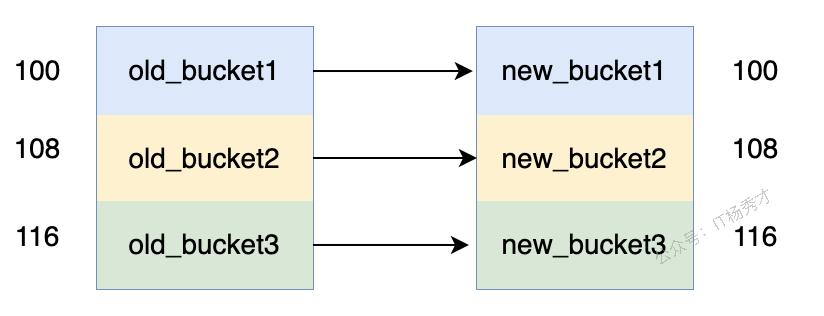
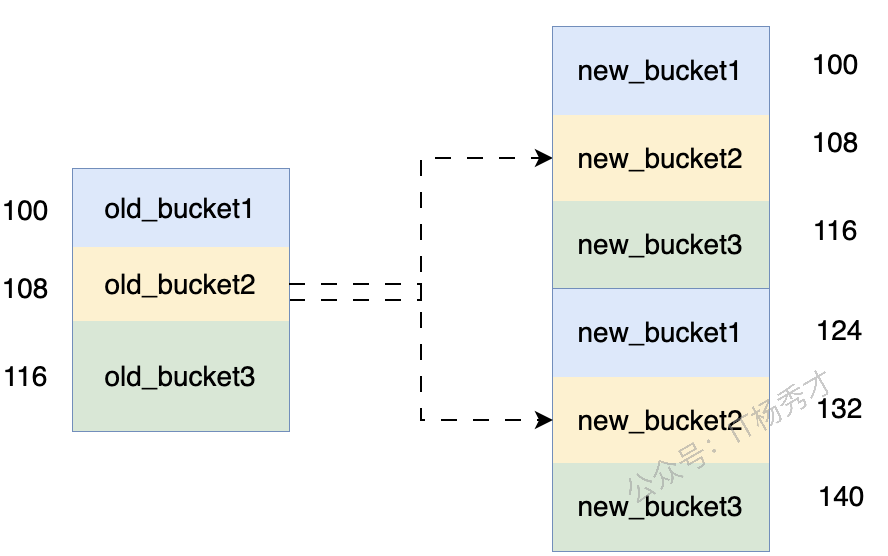
* 数据迁移时,根据扩容规则,可能是迁移到大小相同的buckets上,也可能迁移到2倍大的buckets上。
|
||
|
||
如果迁移到等量数组上,则迁移完的目标桶位置还是在原先的位置上的,如果是双倍扩容迁移到2倍桶数组上,迁移完的目标桶位置有可能在原位置,也有可能在原位置+偏移量。(偏移量大小为原桶数组的长度)。xy 标记目标迁移位置,x 标识的是迁移到相同的位置,y 标识的是迁移到2倍桶数组上的位置。
|
||
|
||
解释一下:
|
||
|
||
```go
|
||
var xy [2]evacDst
|
||
x := &xy[0]
|
||
x.b = (*bmap)(add(h.buckets, oldbucket*uintptr(t.bucketsize)))
|
||
x.k = add(unsafe.Pointer(x.b), dataOffset)
|
||
x.e = add(x.k, bucketCnt*uintptr(t.keysize))
|
||
|
||
if !h.sameSizeGrow() {
|
||
// Only calculate y pointers if we're growing bigger.
|
||
// Otherwise GC can see bad pointers.
|
||
y := &xy[1]
|
||
y.b = (*bmap)(add(h.buckets, (oldbucket+newbit)*uintptr(t.bucketsize)))
|
||
y.k = add(unsafe.Pointer(y.b), dataOffset)
|
||
y.e = add(y.k, bucketCnt*uintptr(t.keysize))
|
||
}
|
||
```
|
||
|
||
evacDst结构如下:
|
||
|
||
```go
|
||
type evacDst struct {
|
||
b *bmap // 迁移桶
|
||
i int // 迁移桶槽下标
|
||
k unsafe.Pointer // 迁移桶Key指针
|
||
e unsafe.Pointer // 迁移桶Val指针
|
||
}
|
||
```
|
||
|
||
* 确定完bucket之后,就会按照bucket内的槽位逐条迁移key/value键值对。
|
||
|
||
* 迁移完一个桶后,迁移标记位nevacuate+1,当nevacuate等于旧桶数组大小时,迁移完成,释放*旧的桶数组和旧的溢出桶数组*
|
||
|
||
扩容过程大概如下图所示:
|
||
|
||
|
||
|
||
等量扩容
|
||
|
||
等量扩容,目标桶再扩容后还在原位置处
|
||
|
||
|
||
|
||
双倍扩容
|
||
|
||
双倍扩容,目标桶扩容后的位置可能在原位置也可能在原位置+偏移量处。
|
||
|
||
### map的删除原理
|
||
|
||
map的delete原理很简单,其核心代码位于`runtime.mapdelete函`数中,这里就不贴完整函数了,删除动作前整体逻辑和前面map的访问差不多,也是map的写检测,以及寻找bucket和key的过程。
|
||
|
||
清空key/value的核心代码如下:
|
||
|
||
```go
|
||
for {
|
||
b.tophash[i] = emptyRest
|
||
if i == 0 {
|
||
if b == bOrig {
|
||
break // beginning of initial bucket, we're done.
|
||
}
|
||
// Find previous bucket, continue at its last entry.
|
||
c := b
|
||
for b = bOrig; b.overflow(t) != c; b = b.overflow(t) {
|
||
}
|
||
i = bucketCnt - 1
|
||
} else {
|
||
i--
|
||
}
|
||
if b.tophash[i] != emptyOne {
|
||
break
|
||
}
|
||
}
|
||
```
|
||
|
||
如果在找到了目标key,则把当前桶该槽位对应的key和value删除,将该槽位的tophash置为emptyOne,如果发现当前槽位后面没有元素,则将tophash设置为emptyRest,并循环向前检查前一个元素,若前一个元素也为空,槽位状态为emptyOne,则将前一个元素的tophash也设置为emptyRest。这样做的目的是将emptyRest状态尽可能地向前面的槽推进,这样做是为了增加效率,因为在查找的时候发现了emptyRest状态就不用继续往后找了,因为后面没有元素了。
|
||
|
||
举个例子:
|
||
|
||
假设当前map的状态如下图所示,溢出桶2后面没有在接溢出桶,或者是溢出桶2后面接的溢出桶中没有数据,溢出桶2中有三个空槽,即第2,3,6处为emptyOne,
|
||
|
||
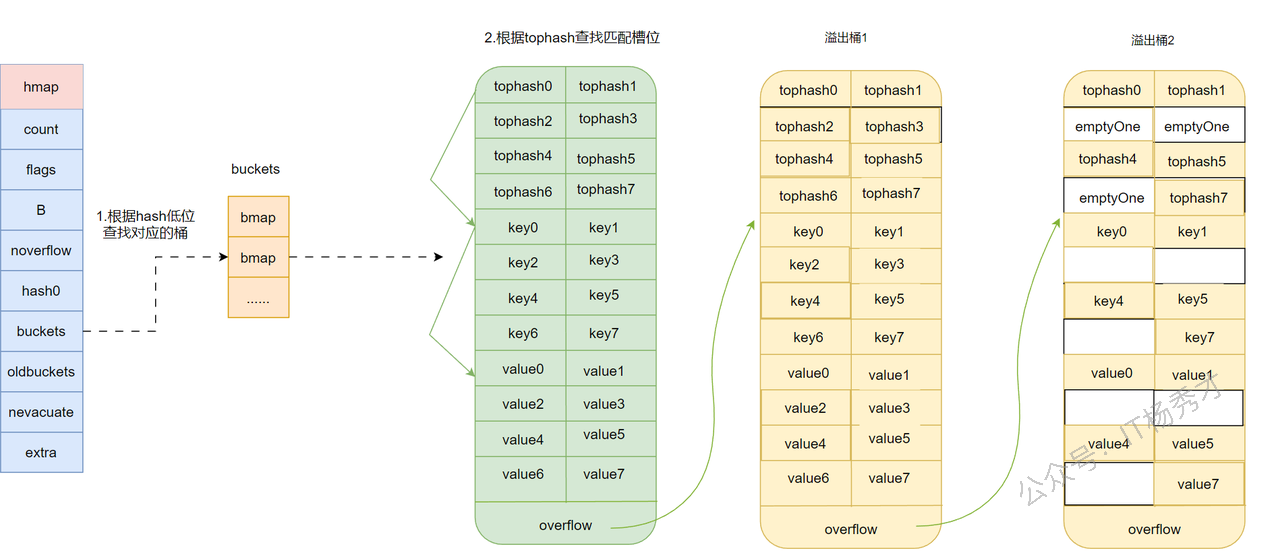
|
||
|
||
在删除了溢出桶1的key2和key4,以及溢出桶2的key7之后,对应map状态如下:
|
||
|
||
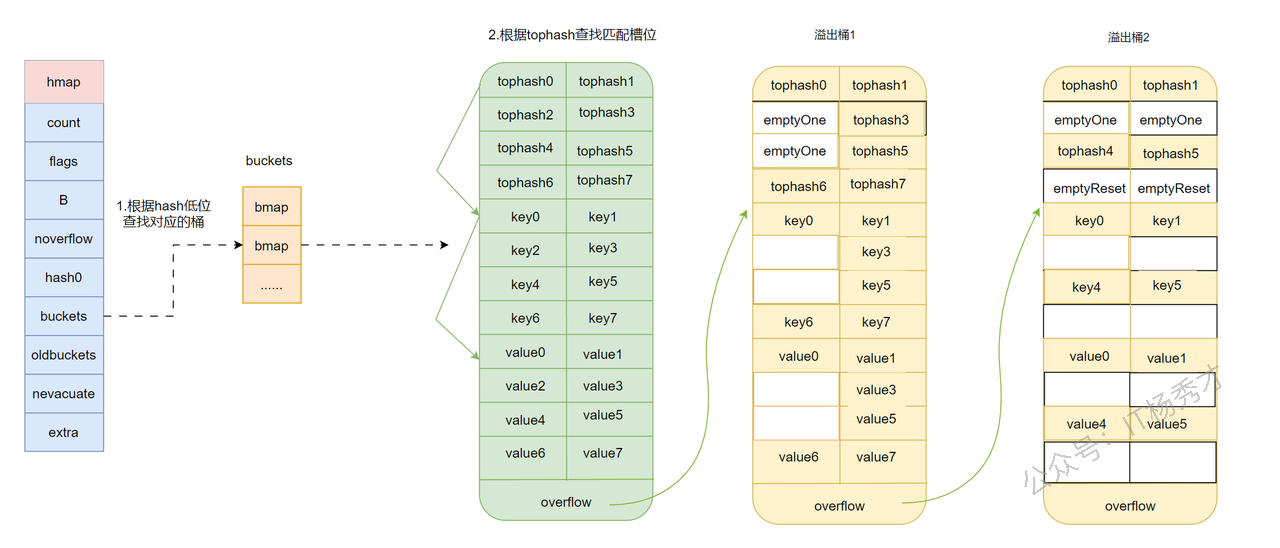
|
||
|
||
|
||
|
||
从delete map单个key/value的原理可以看出,当我们删除一个键值对的时候,这个键值对在桶中的内存并不会被释放,所以对与map的频繁写入和删除可能会造成内存泄漏。
|
||
|
||
### map的遍历
|
||
|
||
go语言中map的遍历尤其要引起注意,因为每次遍历的数据顺序都是不同的。这是因为go在每次开始遍历前,都会随机选择一个桶下标,一个桶内遍历的起点槽下标,遍历的时候从这个桶开始,在遍历每个桶的时候,都从这个槽下标开始
|
||
|
||
go语言为什么要用这种随机开始的位置开始遍历呢?
|
||
|
||
一方面:因为go的扩容不是一个原子操作,是渐进式的,所以在遍历map的时候,可能发生扩容,一旦发生扩容,key 的位置就发生了重大的变化,下次遍历map的时候结果就不可能按原来的顺序了。
|
||
|
||
另一方面:hash 表中数据每次插入的位置是变化的,同一个 map 变量内,数据删除再添加的位置也有可能变化,因为在同一个桶及溢出链表中数据的位置不分先后
|
||
|
||
所以理论上,map的遍历结果就是不同的,所以Go防止用户错误的依赖于每次迭代的顺序,索性每次遍历时,搜是随机选取的一个遍历开始位置。
|
||
|
||
##### 遍历过程
|
||
|
||
###### 迭代器
|
||
|
||
运行时,map的遍历是依靠一个迭代器来完成的,迭代器的代码定义如下:
|
||
|
||
```go
|
||
type hiter struct {
|
||
key unsafe.Pointer // Must be in first position. Write nil to indicate iteration end (see cmd/compile/internal/walk/range.go).
|
||
elem unsafe.Pointer // Must be in second position (see cmd/compile/internal/walk/range.go).
|
||
t *maptype
|
||
h *hmap
|
||
buckets unsafe.Pointer // bucket ptr at hash_iter initialization time
|
||
bptr *bmap // current bucket
|
||
overflow *[]*bmap // keeps overflow buckets of hmap.buckets alive
|
||
oldoverflow *[]*bmap // keeps overflow buckets of hmap.oldbuckets alive
|
||
startBucket uintptr // bucket iteration started at
|
||
offset uint8 // intra-bucket offset to start from during iteration (should be big enough to hold bucketCnt-1)
|
||
wrapped bool // already wrapped around from end of bucket array to beginning
|
||
B uint8
|
||
i uint8
|
||
bucket uintptr
|
||
checkBucket uintptr
|
||
}
|
||
```
|
||
|
||
字段释义:
|
||
|
||
| 字段 | 释义 |
|
||
| ------------ | -------------------------------------------------------------- |
|
||
| key | 键值对的键,键必须放置在第一个字段,key为空指针nil说明遍历结束 |
|
||
| elem | 键值对的值,值放置在第二个字段 |
|
||
| buckets | 桶数组指针,指向迭代器初始化之后要遍历的桶数组 |
|
||
| h | map的地址 |
|
||
| t | map的类型信息 |
|
||
| bptr | 指向当前遍历到的桶的指针 |
|
||
| overflow | hmap中正常桶的溢出桶指针 |
|
||
| oldoverflow | 发生扩容时,hmap中旧桶的溢出桶指针 |
|
||
| startBucket | 开始遍历时,初始化的桶下标 |
|
||
| offset | 开始遍历时,初始化的槽位下标 |
|
||
| wrapped | 表示是否遍历完了,true表示遍历完了 |
|
||
| B | 初始化迭代器时,h.B |
|
||
| i | 当前桶已经遍历的键值对数量,i=0时,开始遍历当前桶的第一个槽位,i=8时,当前桶已经遍历完,将 it.bptr指向下一个桶 |
|
||
| bucket | 当前遍历桶的偏移量 |
|
||
| checkBucket | 桶状桶状态标记位,如果不是noCheck,则表明当前桶还没有迁移, |
|
||
|
||
整个遍历的过程大致可以分为两步
|
||
|
||
1. 初始化迭代器
|
||
|
||
2. 开始一轮遍历
|
||
|
||
初始化迭代器的工作主要在函数`mapiterinit(t `*`maptype, h `*`hmap, it *hiter)`中完成,源代码如下:
|
||
|
||
```go
|
||
// mapiterinit initializes the hiter struct used for ranging over maps.
|
||
// The hiter struct pointed to by 'it' is allocated on the stack
|
||
// by the compilers order pass or on the heap by reflect_mapiterinit.
|
||
// Both need to have zeroed hiter since the struct contains pointers.
|
||
func mapiterinit(t *maptype, h *hmap, it *hiter) {
|
||
if raceenabled && h != nil {
|
||
callerpc := getcallerpc()
|
||
racereadpc(unsafe.Pointer(h), callerpc, abi.FuncPCABIInternal(mapiterinit))
|
||
}
|
||
|
||
it.t = t
|
||
if h == nil || h.count == 0 {
|
||
return
|
||
}
|
||
|
||
if unsafe.Sizeof(hiter{})/goarch.PtrSize != 12 {
|
||
throw("hash_iter size incorrect") // see cmd/compile/internal/reflectdata/reflect.go
|
||
}
|
||
it.h = h
|
||
|
||
// grab snapshot of bucket state
|
||
it.B = h.B
|
||
it.buckets = h.buckets
|
||
if t.bucket.ptrdata == 0 {
|
||
// Allocate the current slice and remember pointers to both current and old.
|
||
// This preserves all relevant overflow buckets alive even if
|
||
// the table grows and/or overflow buckets are added to the table
|
||
// while we are iterating.
|
||
h.createOverflow()
|
||
it.overflow = h.extra.overflow
|
||
it.oldoverflow = h.extra.oldoverflow
|
||
}
|
||
|
||
// decide where to start
|
||
r := uintptr(fastrand())
|
||
if h.B > 31-bucketCntBits {
|
||
r += uintptr(fastrand()) << 31
|
||
}
|
||
it.startBucket = r & bucketMask(h.B)
|
||
it.offset = uint8(r >> h.B & (bucketCnt - 1))
|
||
|
||
// iterator state
|
||
it.bucket = it.startBucket
|
||
|
||
// Remember we have an iterator.
|
||
// Can run concurrently with another mapiterinit().
|
||
if old := h.flags; old&(iterator|oldIterator) != iterator|oldIterator {
|
||
atomic.Or8(&h.flags, iterator|oldIterator)
|
||
}
|
||
|
||
mapiternext(it) // 进行单次遍历
|
||
}
|
||
```
|
||
|
||
主要工作分为以下几步:
|
||
|
||
1. 判断map是否为空
|
||
|
||
2. 随机一个开始遍历的起始桶下标
|
||
|
||
3. 随机一个槽位下标,后续每个桶内的遍历都从这个槽位开始
|
||
|
||
4. 把map置为遍历状态
|
||
|
||
5. 开始执行一次遍历过程
|
||
|
||
单次遍历的工作主要在`mapiternext(it *hiter)`函数中完成,源代码如下:
|
||
|
||
```go
|
||
func mapiternext(it *hiter) {
|
||
h := it.h
|
||
if raceenabled {
|
||
callerpc := getcallerpc()
|
||
racereadpc(unsafe.Pointer(h), callerpc, abi.FuncPCABIInternal(mapiternext))
|
||
}
|
||
if h.flags&hashWriting != 0 { // map的并发写判断
|
||
throw("concurrent map iteration and map write")
|
||
}
|
||
t := it.t // 获取上次迭代进度
|
||
bucket := it.bucket
|
||
b := it.bptr
|
||
i := it.i
|
||
checkBucket := it.checkBucket
|
||
|
||
next: // 开始一次迭代
|
||
if b == nil { // 遍历未开始或者当前正常桶(桶数组中的桶)的溢出桶(同数组的溢出表链表中的桶)经遍历完了,开始遍历下一个正常桶
|
||
if bucket == it.startBucket && it.wrapped { // 遍历位置是起始桶,并且wrapped为true,说明遍历完了,直接返回
|
||
// end of iteration
|
||
it.key = nil
|
||
it.elem = nil
|
||
return
|
||
}
|
||
// 如果map正在扩容,判断当前遍历的桶数据是否已经迁移完,迁移完了则使用新桶,否则使用旧桶
|
||
if h.growing() && it.B == h.B {
|
||
// Iterator was started in the middle of a grow, and the grow isn't done yet.
|
||
// If the bucket we're looking at hasn't been filled in yet (i.e. the old
|
||
// bucket hasn't been evacuated) then we need to iterate through the old
|
||
// bucket and only return the ones that will be migrated to this bucket.
|
||
oldbucket := bucket & it.h.oldbucketmask()
|
||
b = (*bmap)(add(h.oldbuckets, oldbucket*uintptr(t.bucketsize)))
|
||
if !evacuated(b) {
|
||
checkBucket = bucket
|
||
} else {
|
||
b = (*bmap)(add(it.buckets, bucket*uintptr(t.bucketsize)))
|
||
checkBucket = noCheck
|
||
}
|
||
} else {
|
||
b = (*bmap)(add(it.buckets, bucket*uintptr(t.bucketsize)))
|
||
checkBucket = noCheck
|
||
}
|
||
bucket++
|
||
if bucket == bucketShift(it.B) { // 遍历到了数组最后,从头开始继续遍历
|
||
bucket = 0
|
||
it.wrapped = true
|
||
}
|
||
i = 0
|
||
}
|
||
for ; i < bucketCnt; i++ { // 遍历当前桶和当前桶的溢出桶里的数据
|
||
offi := (i + it.offset) & (bucketCnt - 1) // 通过初始化的槽位下表确定将要遍历的槽位的tophash
|
||
if isEmpty(b.tophash[offi]) || b.tophash[offi] == evacuatedEmpty {
|
||
// TODO: emptyRest is hard to use here, as we start iterating
|
||
// in the middle of a bucket. It's feasible, just tricky.
|
||
continue
|
||
}
|
||
k := add(unsafe.Pointer(b), dataOffset+uintptr(offi)*uintptr(t.keysize)) // 根据偏移量i确定key和value的地址
|
||
if t.indirectkey() {
|
||
k = *((*unsafe.Pointer)(k))
|
||
}
|
||
e := add(unsafe.Pointer(b), dataOffset+bucketCnt*uintptr(t.keysize)+uintptr(offi)*uintptr(t.elemsize))
|
||
if checkBucket != noCheck && !h.sameSizeGrow() {
|
||
// Special case: iterator was started during a grow to a larger size
|
||
// and the grow is not done yet. We're working on a bucket whose
|
||
// oldbucket has not been evacuated yet. Or at least, it wasn't
|
||
// evacuated when we started the bucket. So we're iterating
|
||
// through the oldbucket, skipping any keys that will go
|
||
// to the other new bucket (each oldbucket expands to two
|
||
// buckets during a grow).
|
||
// 这里处于增量扩容,需要进一步判断
|
||
// 如果数据还没有从旧桶迁移到新桶,需要计算这个key重新hash计算后是否与oldbucket的索引一致,不一致则跳过
|
||
if t.reflexivekey() || t.key.equal(k, k) {
|
||
// If the item in the oldbucket is not destined for
|
||
// the current new bucket in the iteration, skip it.
|
||
hash := t.hasher(k, uintptr(h.hash0))
|
||
if hash&bucketMask(it.B) != checkBucket {
|
||
continue
|
||
}
|
||
} else {
|
||
// Hash isn't repeatable if k != k (NaNs). We need a
|
||
// repeatable and randomish choice of which direction
|
||
// to send NaNs during evacuation. We'll use the low
|
||
// bit of tophash to decide which way NaNs go.
|
||
// NOTE: this case is why we need two evacuate tophash
|
||
// values, evacuatedX and evacuatedY, that differ in
|
||
// their low bit.
|
||
if checkBucket>>(it.B-1) != uintptr(b.tophash[offi]&1) {
|
||
continue
|
||
}
|
||
}
|
||
}
|
||
if (b.tophash[offi] != evacuatedX && b.tophash[offi] != evacuatedY) ||
|
||
!(t.reflexivekey() || t.key.equal(k, k)) { // 这里的数据没有处在扩容中,直接使用
|
||
// This is the golden data, we can return it.
|
||
// OR
|
||
// key!=key, so the entry can't be deleted or updated, so we can just return it.
|
||
// That's lucky for us because when key!=key we can't look it up successfully.
|
||
it.key = k
|
||
if t.indirectelem() {
|
||
e = *((*unsafe.Pointer)(e))
|
||
}
|
||
it.elem = e
|
||
} else {
|
||
// The hash table has grown since the iterator was started.
|
||
// The golden data for this key is now somewhere else.
|
||
// Check the current hash table for the data.
|
||
// This code handles the case where the key
|
||
// has been deleted, updated, or deleted and reinserted.
|
||
// NOTE: we need to regrab the key as it has potentially been
|
||
// updated to an equal() but not identical key (e.g. +0.0 vs -0.0).
|
||
rk, re := mapaccessK(t, h, k) // 走到这里,表明这条数据已经被迁移或者删除,使用mapaccessK去找回这部分的数据
|
||
if rk == nil {
|
||
continue // key has been deleted 数据没找到,说明已经删除
|
||
}
|
||
it.key = rk
|
||
it.elem = re
|
||
}
|
||
it.bucket = bucket // 记录本次遍历进度
|
||
if it.bptr != b { // avoid unnecessary write barrier; see issue 14921
|
||
it.bptr = b
|
||
}
|
||
it.i = i + 1
|
||
it.checkBucket = checkBucket
|
||
return
|
||
}
|
||
b = b.overflow(t) // 遍历溢出桶链表:继续遍历下一个溢出桶
|
||
i = 0
|
||
goto next
|
||
}
|
||
```
|
||
|
||
遍历的流程大致是以下几个步骤:
|
||
|
||
1. map的并发写检测,判断map是否处于并发写状态,是则panic
|
||
|
||
2. 判断是否已经遍历完了,遍历完了直接退出
|
||
|
||
3. 开始遍历
|
||
|
||
4. 首选确定一个随机开始遍历的起始桶下标作为startBucket,然后确定一个随机的槽位下标作为offset
|
||
|
||
5. 根据startBucket和offset开始遍历当前桶和当前桶的溢出桶,如果当前桶正在扩容,则进行步骤6,否则进行步骤7
|
||
|
||
6. 在遍历处于扩容状态的bucket的时候,因为当前bucket正在扩容,我们并不会遍历这个桶,而是会找到这个桶的旧桶old\_bucket,遍历旧桶中的一部分key,这些key重新hash计算后能够散列到bucket中,对那些key经过重新hash计算不散列到bucket中的key,则跳过
|
||
|
||
7. 根据遍历初始化的时候选定的随机槽位开始遍历桶内的各个key/value
|
||
|
||
8. 继续遍历bucket溢出指针指向的溢出链表中的溢出桶
|
||
|
||
9. 假如遍历到了起始桶startBucket,则说明遍历完了,结束遍历
|
||
|
||
|
||
|
||
|
||
|